
Attributing the stock market crash to global turbulence, Finance Minister Arun Jaitley on Monday said the government and RBI were watching the situation and hoped that things will stabilise once the transient impact is over.
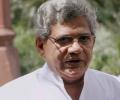
Yechury said the aim should be how to protect our economy from slowdown

'For the first month, we have only had 5.5 million who have paid the tax.' '40 per cent have paid nil as tax; 95 per cent of the taxation for the first two months has come from only 400,000 assessees.' 'So even now, the tax-paying habit, of paying a marginal or negligible amount, or not paying anything at all, is quite prevalent,' reveals Finance Minister Arun Jaitley.
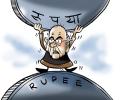
Fiscal deficit in first half of FY19 has already reached 95.3 per cent of full-year budget estimates.

On indirect tax front, the government will earn 21 paise from excise and customs.

The FM could scrap the secrecy around tax rates.

Economist Jayati Ghosh noted that the word 'freebies' indicates the class position of those who use it.

The tax, in lieu of local levies, will be imposed at the first point of a financial transaction.

On Thursday, the bench, after perusing the plea copy, noted that Wankhede had approached the Central Administrative Tribunal, too, against the notices issued to him by the NCB.
The fiscal deficit was 4.9 per cent of GDP in 2012-13.
The bill to nullify retrospective taxation offers a fair solution within the framework of Indian law and Parliamentary sovereignty to companies which have been subjected to such demands, Finance Secretary T V Somanathan said on Thursday. Finance Minister Nirmala Sitharaman introduced 'The Taxation Laws (Amendment) Bill, 2021' in the Lok Sabha that seeks to withdraw tax demands made using a 2012 retrospective legislation to tax the indirect transfer of Indian assets. The Bill provides for the withdrawal of tax demand made on "indirect transfer of Indian assets if the transaction was undertaken before May 28, 2012 (i.e. the day the retrospective tax legislation came into being)."
.jpg)
The GST will subsume most of the indirect taxes like excise duty and service tax

The opposition parties vehemently criticised the new 'one nation, one tax' system having four different rates instead of a single rate adopted in some countries including the UK and Singapore.

'The prospects for both India and the global economy is that we are headed towards a very difficult time.' 'I see very uncertain at least 8-10 months for both India and the rest of the world.'

The Centre's revenue from GST registered a decline of 10 per cent in 2017-18 compared to revenue of subsumed taxes in 2016-17.

Years of wait before DTC, GST are rolled out

The Income-Tax (I-T) department has issued around 8,000 notices to salaried employees, self-employed individuals, and companies who made significant donations to charitable trusts. The department suspects potential tax evasion, as records of these donations do not correspond with the income and expenses of those making them. Sandeep Bajaj, managing partner, PSL Advocates & Solicitors, says, "Notices were issued for donations made during the assessment years of 2017-18 through 2020-21."

Revenue from service tax, which has become a new focus area for Finance Ministry, has grown up substantially by over 300 times in past about two decades.
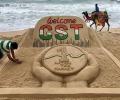
Businesses with monthly turnover of over Rs 50 lakh will have to mandatorily pay at least 1 per cent of their GST liability in cash, the finance ministry said as it moved to curb evasion by fake invoicing. The Central Board of Indirect Taxes and Customs (CBIC) has introduced Rule 86B in Goods and Services Tax (GST) rules which restricts use of input tax credit (ITC) for discharging GST liability to 99 per cent. "... The registered person shall not use the amount available in electronic credit ledger to discharge his liability towards output tax in excess of 99 per cent of tax liability, in cases where the value of taxable supply ... in a month exceeds Rs 50 lakh," the CBIC said.
Questions will be raised over why those changes take place and whether non-economic factors are at play, says A K Bhattacharya.
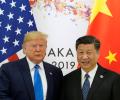
'If you compare the data from 2017 and 2023 of the US imports from the world and China, you will see that the US was a complete loser in the trade war, and China was a complete gainer.'
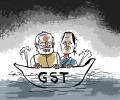
Agra has long been known for the Taj Mahal, but it is also a manufacturing hub filled with micro, small and medium enterprises (MSMEs) that make everything from electronic components to metal products, from paints and chemicals to footwear. And five years after the introduction of the Goods and Services Tax (GST), the MSMEs here complain that while the indirect tax regime has been transformative, cutting out the need to file multiple taxes, its biggest drawback has been the delay in credit refunds. Whoever you speak to - MSME owners, tax lawyers, or industry bodies like the National Chambers of Industries and Commerce (NCIC), Agra Footwear Manufacturers and Exporters Chamber (AFMEC) and Agra Shoe Manufacturers Association (ASMA) - they all emphasise that the GST continues to face some key challenges.
The Economic Survey states that the rationalisation and reprioritisation of subsidies through better targeting would play a vital role in fiscal consolidation and in targeting expenditure more towards inclusive development.

Hindi film industry hopes to get some tax relief from the upcoming Budget 2015-16.

Experts said the slowdown could be attributed to adjustments leading to destocking and the offering of discounts by companies as the government ushered in the new indirect taxation system on July 1.

In years past, we often approached the Budget expecting to see changes in direct and indirect taxes. Those days are behind us. The Budget of today seeks to expand the economy and keep it at the forefront of technology, observes Harsh Goenka.

Besides Vodafone, several other major MNCs like Nokia and Shell were locked in tax dispute with the revenue department.

Never before in post-reforms India have Union Budgets seen a steady reduction in fiscal deficit for five consecutive years, points out A K Bhattacharya.
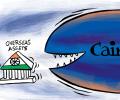
The government on Thursday brought a bill in the Lok Sabha to withdraw all back tax demands on companies such as Cairn Energy and Vodafone and said it will refund the money collected to enforce such levies.

Every bank offers a different slab of minimum balance to customers, based on which 'free services' are provided

The fiscal gains from implementing the GST and demonetisation, while almost certain to occur, will probably take time to be fully realised

The oil crisis could not have come at a worse time for the Modi government as its tax collection has fallen short of its 2020-2021 target by Rs 5.2 lakh crore.
After the RBI surprised the Centre with a record Rs 99,122 crore in surplus transfer for FY21, analysts said this will help the government tide over the revenue losses from lockdowns and extend more support to the pandemic hit industries and to the poor people. In fiscal 2020, the RBI had paid only Rs 57,128 crore in dividend to the government and the finance minister had budgeted only Rs 45,000 crore from the central bank. The higher payout followed the Bimal Jalan panel report that had set a new economic framework capital buffer for the central bank along with the contingency risk buffer at 5.5 per cent.
The CAG audit and other data suggests it could be far from the efficient new alternative that was once conceptualised. A conclusive review remains elusive till the government begins to release more granular and comparable data on the complex backend of GST to a deeper scrutiny, by researchers, auditors and the public.

With the industrial production dragging the overall growth down, it said the government must also focus on the manufacturing sector by reducing the "infrastructure deficit".

With this, India joins 60 other countries that collect PNR details of international passengers.

For every Re in govt coffer, one-fourth will come from market borrowing.

How investors can tweak their fixed income investments to earn more in the current environment.

The government is expected to dole out some populist policies, especially for the rural / farm sector while presenting the interim budget, given that the country is heading towards general elections over the next few months.

The sentence could go up to three years if the evasion exceeds Rs 50 lakh (5 million).
